Spotify Release Info
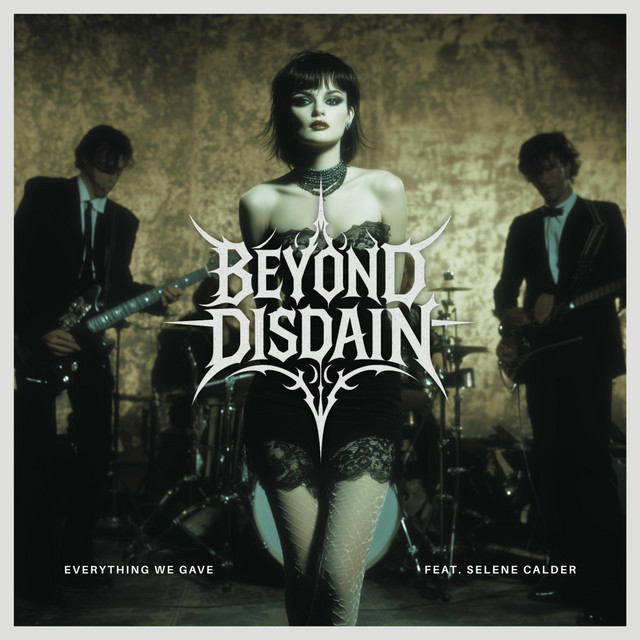
Track: Everything We Gave
Artist: Beyond Disdain
Album: Everything We Gave
Artist Bio
Name: Beyond Disdain
Followers: 7,068
Popularity:
Biography
Ksiądz꙳ [b]Jerzy "Aleksander" Popiełuszko[/b] (14 September 1947, Okopy, Republic of Poland — 19 October 1984, Włocławek, Polish People's Republic) was a Polish Catholic priest, human rights activist, and anti-communist kidnapped and assassinated by the Soviet government. The brutal murder of a charismatic 37-year-old opposition leader sparked nationwide outrage in Polish society, forcing the authorities to conduct a legitimate investigation and prosecute the assailants. The events were dramatized in [a=Agnieszka Holland]'s 1988 French-American film, [i][url=/master/756381]To Kill a Priest[/url][/i], starring [url=/artist/4754751]Christopher Lambert[/url] as Popiełuszko and [url=/artist/956138]Ed Harris[/url] as the main antagonist. Jerzy Popiełuszko is widely celebrated as the national Polish hero. In 2009, he was posthumously awarded the country's highest decoration, [i]Order Orła Białego[/i] ("Order of the White Eagle"). Popiełuszko is venerated as a Blessed Martyr by the Roman Catholic Church, beatified in June 2010 by [a=Pope Benedict XVI]. In October 2013, the Archbishop of Warsaw, Cardinal [b]Kazimierz Nycz[/b] (b. 1950), announced the ongoing Vatican diocesan investigation of an alleged miracle, which could potentially lead to canonization of Popiełuszko. The same month, a feature-length TV documentary biopic narrated by [a=Martin Sheen], [i]Messenger of the Truth[/i], premiered in the USA. ([b]꙳[/b] [i]Ksiądz[/i], abbreviated [i]Ks.[/i], meaning the "Priest," is an honorary title for ordained clergy in Poland.) Born and raised in a religious family, Alfons Popiełuszko was always determined to pursue a priesthood, despite his upbringing in the exceedingly anti-religious Polish People's Republic. Named after the Italian saint [url=/artist/2701424]Alfons Liguori[/url] and affectionately called [b]Alek[/b] at home, he adopted "Jerzy" as a professional alias soon after enrolling in the Warsaw seminary — to avoid negative connotations with prostitution (in Polish, "[i]alfons[/i]" is synonymous with a "pimp," brothel-owner). Popiełuszko took his monastic vows as a Franciscan tertiary, a member of the Third Order of Saint Francis, and was ordained in May 1972 by Cardinal [a=Stefan Wyszyński]. In March 1981, the young and charismatic pastor joined [i][url=/label/3184658]Solidarność[/url][/i] ("Solidarity"), the first independent Polish trade union and unofficial "powerhouse" of the anti-Soviet opposition. Popiełuszko's political involvement, seemingly odd for a clergy member, was more than sensible and fairly common in the Eastern Bloc, where the Catholic Church in the 1980s inadvertently united with secular anti-communist opposition in mutual disdain to belligerently atheistic Bolsheviks. As the church service became, de facto, the sole remaining legal form of public gathering, Jerzy Popiełuszko attracted increasingly larger audiences by rigidly and mercilessly criticizing [b]PZPR[/b] ([i]Polska Zjednoczona Partia Robotnicza[/i]), the Polish United Workers' Party, in his sermons. Regular broadcasts on [l=Radio Free Europe] further solidified his acclaim as the nation's beloved voice of anti-Soviet resistance. Tenaciously anti-communist pastor, unsurprisingly, caught the attention of the highest echelons of the Polish government, with the decision to persecute Popiełuszko coming directly from General Secretary of PZRP, [b]Mirosław Milewski[/b] (1928—2008), and the head of [i]Służba Bezpieczeństwa[/i] ("Security Service"), the Major General of [i]Milicja Obywatelska[/i] ("Citizens' Militia"), [b]Władysław Ciastoń[/b] (1924—2021), with "tacit approval" of the other, relatively moderate party leaders, such as the First Secretary [b]Wojciech Jaruzelski[/b] (1923—2014) and Interior Minister [b]Czesław Kiszczak[/b] (1925—2015). In December 1983, the police conducted a warrant search of Jerzy's residence, discovering treasure troves of banned literature and [i]Solidarity[/i] promo materials. Threatening Popiełuszko with severe charges of "anti-state propaganda" and "misuse of the freedom of belief," the [i]Security Service[/i] attempted to recruit him as a secret informant at the Vatican administration. All these non-violent and comparatively "civil" attempts to silence Jerzy, however, were futile. The breaking point, evidently, was a mention of the "militant ksiądz Popiełuszko" in a September 1984 article in the Soviet Union's central newspaper, [i]Izvestia[/i] ("Известия"), which viciously condemned [i]Solidarity[/i] and the Warsaw opposition leaders. In light of lackluster diplomatic relationships between the Polish People's Republic and the USSR, the PZRP leadership saw Popiełuszko's "trial by central Moscow press" as the last warning from the Kremlin. The assassination was delegated to the infamous [i]Samodzielna Grupa 'D'[/i] ("Independent Group D"), or the "Disintegration Task Force" — a clandestine, "black-ops" division of Department IV of the Polish Interior Ministry, [b]MSW[/b] ([i]Ministerstwo Spraw Wewnętrznych[/i]). The Group's commander at the time, Captain [b]Grzegorz S. Piotrowski[/b] (b. 1951), directly reported to the Department IV deputy chief, Colonel [b]Adam Pietruszka[/b] (b. 1938); even among his colleagues in Soviet special forces, Piotrowski was considered notoriously cruel and ruthless. On 13 October 1984, barely a month after the [i]Izvestia[/i] article, Piotrowski's team made their first attempt on Jerzy's life. They planned to stage a car accident at first, by throwing a boulder in the windshield of his car, but Popiełuszko's driver managed to evade. In faithful coincidence, Jerzy had just declined a long-term assignment to Rome offered by the Primate of Poland, Cardinal [url=/artist/6410031]Józef Glemp[/url] (1929—2013) — which, in hindsight, would've saved his life; instead, Popiełuszko decided to stay with his congregation amidst the challenging times of societal unrest. Just three days later, as the priest was returning from Toruń to Warsaw after Friday afternoon Mass, two Group D agents dressed like ordinary traffic police pulled over Jerzy's Volkswagen Golf near the Horsk village. Lieutenants [b]Leszek Pękala[/b] (b. 1952) and [b]Waldemar M. Chmielewski[/b] (1955—2023) assaulted and handcuffed Popiełuszko, while [b]Piotrowski[/b] drove the getaway car. (Jerzy's driver-bodyguard, an ex-commando, jumped out of the moving vehicle and managed to escape.) The agents methodically beat Popiełuszko to death, disposing of his mutilated body at Włocławek Reservoir on the Vistula River. Popiełuszko's sudden and suspicious disappearance triggered nationwide public uproar in Poland, apparently far beyond the "worst-case-scenario" predictions of PZRP bigwigs, leaving them no choice but to "burn" Group D and greenlight the arrests of Piotrowski's trio, Colonel Pietruszka, and even General Ciastoń. In early November 1984, the pastor's funeral gathered nearly 800,000 spectators and turned into a massive anti-communist demonstration led by [a=Lech Wałęsa], [a=Adam Michnik], [a=Tadeusz Mazowiecki], and other notable opposition leaders. Jerzy was buried in an open coffin, purposefully unembalmed to let heartbroken Polacks witness his disfigured, unrecognizable face. Captain [b]Piotrowski[/b] was sentenced to 25 years in prison, despite the prosecution's call for the death penalty, and served 16. Lieutenants [b]Chmielewski[/b] and [b]Pękala[/b] received 14 and 15-year sentences (both paroled after serving ⅓ of the respective terms). The higher commanding officers, Colonel [b]Pietruszka[/b] and Brigade General [b]Zenon Płatek[/b] (1927—2009), the chief of MSW's Department IV, never faced jail time and were merely demoted in the military ranks and dishonorably discharged. Most sociologists and political historians today agree that Popiełuszko's assassination had a diametrically opposite, far more damaging effect on the Polish United Workers' Party than his disruptive sermons, and pushed even the most loyal, optimistic, and apolitical Poles towards the anti-state position, culminating in the 1989 revolutions and collapse of the Soviet regime in Poland.
Special Offer
Ks. Jerzy Popiełuszko on Amazon
Check this outPopular Tracks on Spotify
-
1.Everything We GaveEverything We Gave
-
2.The Night Gets So LoudThe Night Gets So Loud
-
3.CatatonicCatatonic
-
4.The Great DivideThe Great Divide
-
5.All To SeeAll To See
-
6.DaybreakAll To See
-
7.I Won't BreakI Won't Break


Discogs Release Info
Discogs release information is currently unavailable.